Why is my Google Ads not working? 15 real reasons, fixes & audit checklist (2026)

Why is my Google Ads not working? 15 real reasons, fixes & audit checklist (2026)

If you've typed "Google Ads not working" into a search bar at 11 pm while staring at a dashboard full of spend and no sales, you're in good company. It's one of the most common frustrations in paid search, and almost always, the answer isn't "Google Ads is broken." It's that one (or several) predictable set of things has gone wrong.

We run Google Ads accounts for clients across trades, professional services, and local retail businesses, so this diagnosis is one we run constantly, the same checklist, in the same order, every time a client tells us their Google Ads has "stopped working."

This guide walks through that process: how the platform decides what to show, the 15 real causes behind most under performing accounts, how to check each one yourself, a free audit checklist, and when it's time to bring in a specialist.

  1. How Google Ads actually works (the 60-second version)
  2. Start here: diagnose the type of problem you have
  3. 15 reasons your Google Ads isn't working
  4. Free Google Ads audit checklist
  5. Not sure if it's Google Ads or your website? Get a free audit
  6. Mistakes we see most often in client accounts
  7. Real examples: how we diagnosed three "not working" accounts
  8. Related questions people ask alongside this one
  9. Frequently asked questions
  10. When to hire a Google Ads specialist
  11. References

Most of the 15 reasons below make more sense once you understand the mechanics they're breaking. In short:

  1. Someone's search pattern. Google matches that search against your keywords (or, in Performance Max/Demand Gen, against your assets and signals) alongside every other advertiser targeting similar terms.
  2. An auction runs. Your Ad Rank, a combination of your bid, your Quality Score, and the expected impact of ad extensions, decides whether your ad shows, in what position, and roughly what you'll pay per click.
  3. Quality Score is the multiplier that makes or breaks the economics. Google's own documentation describes it as a diagnostic built from three components: expected click-through rate, ad relevance, and landing page experience. A high score means you pay less for a better position; a low score means you're outbid by competitors even with a bigger budget.
  4. Bidding strategy decides how aggressively Google chases your goal. Manual and Smart Bidding strategies (Maximise Clicks, Target CPA, Target ROAS) all need a data-gathering "learning period" before they stabilize.
  5. Conversion tracking closes the loop. Everything above is optimised toward whatever you've told Google to count as a conversion. So, if that signal is wrong, every downstream decision Google's algorithm makes will be wrong too.

Once you can place your problem somewhere in that five-step chain to diagnose “why your Google Ads isn't working", the issue becomes a lot less overwhelming.

Before you assume Google Ads isn't working, separate the campaign that are "not showing" from those "showing but not converting”, they have completely different fixes.

Google's Quality Score diagnostic tool is the fastest way to see which bucket you're in, because it breaks performance down into those same three components.

This is the single most common reason we hear "my Google Ads isn't working." Broad, high-volume terms feel like the obvious choice, but they often bring in people who were never going to buy eg. browsers, job seekers, DIYers, or people searching for something adjacent to your service.

Diagnose it: Pull your search terms report and read the actual queries triggering your ads, not just the keywords you added. If most of the ads spend is landing on searches only loosely related to what you sell, this is your problem.

Fix it: Rebuild ad groups around tightly themed keyword clusters that mirror real buyer intent. Google's guidance on keyword prioritisation and query matching explains how Google decides which keyword competes in each auction, which makes it much easier to predict and control the searches you'll win.

Broad match sounds efficient. Google finds "similar" searches for you. However, in reality, it can pull in only loosely related queries, particularly on newer or lower-budget accounts that haven't built up enough conversion data for Smart Bidding to compensate.

Diagnose it: In the search terms report, filter by match type. If broad match keywords are generating high spend and low conversion rate relative to phrase/exact, that's your signal.

Fix it: For anything transactional, lean on phrase and exact match. Save broad match for well-optimised campaigns feeding a strong automated bidding strategy with a solid conversion history. The Search Engine Journal guide to query matching controls is a useful primer on how match types interact with Google's prioritisation logic.

This is the fastest, cheapest fix on this list, and the one most account skip. WordStream's analysis of over 15,000 Google Ads accounts found that accounts with even one negative keyword saw far higher conversion rates than accounts with none. Moreso, most accounts without negative keywords have been found to have wasted over £1,000/month on unqualified clicks.

Diagnose it: In the search terms report, sort by cost with zero conversions. Anything irrelevant sitting at the top is money you're actively leaking.

Fix it: Build a negative keyword list and apply it at the account level so it covers every campaign automatically. Google explains the mechanics in its guide to account-level negative keywords.

If your ad copy is generic and doesn't mirror the intent behind the keyword, people scroll past it, even in a good position. Check whether your headlines contain the terms people are searching for, and whether the offer in the ad matches what's on the landing page.

Diagnose it: Compare your Click-Through Rate (CTR) against Google's "Expected CTR" status in the Quality Score columns. "Below average" is a direct signal that relevance is the issue.

Fix it: Split ad groups by theme so each can run tightly targeted copy, rather than one generic ad serving ten search intents at once. This is standard structure advice covered well in PPC Hero's guide to Google Ads account structure.

Quality Score isn't used directly in the auction, but it's the clearest public signal of how Google rates your ad-keyword-landing page relevance, and poor scores mean you pay more for worse positions.

Diagnose it: Add the Quality Score columns (Quality Score, Expected CTR, Ad Relevance, Landing Page Experience) to your keywords view and sort by spend. Anything below 5/10 with real spend behind it needs attention first.

Fix it: Work through each of the three components individually rather than trying to fix "Quality Score" as a singular problem. See Google's guide on using Quality Score to improve performance. Tighter ad groups (reason 4) do more for this metric than almost anything else.

A flat account with a handful of broad campaigns and huge, loosely themed ad groups makes every other problem on this list worse, it dilutes relevance, makes budget allocation blunt, and makes the search terms report almost impossible to action.

Diagnose it: Count the keywords per ad group. If you're seeing 30–50+ keywords spanning multiple product lines or services in one ad group, structure is likely capping your performance.

Fix it: Group keywords by tight themes, separate branded from non-branded traffic, and structure campaigns around business goals or locations rather than convenience. WordStream's 2026 guide to Google Ads account structure and PPC Hero's account structure guide both cover this in detail.

You can do everything else right and still lose the sale here. If the page is slow, unclear, or doesn't match what the ad promised. When visitors bounce on your landing page, Google notices too since landing page experience feeds Quality Score.

Diagnose it: Benchmark yourself honestly. Unbounce's analysis of 41,000 landing pages and 464 million visits puts the median landing page conversion rate at around 6.6%. Their piece on what counts as a good conversion rate explains why comparing your number against similar pages (not an arbitrary target) matters more than the raw figure.

Fix it: Prioritise message match (the headline should echo the ad), page load speed, and a single, obvious call to action. Cut form fields to the minimum you actually need.

Sometimes the keywords are right but the people behind them aren't your buyers. Also, wrong location, wrong budget, wrong stage of the buying journey. This shows up as decent click volume with poor lead quality.

Diagnose it: Cross-reference conversion rate by location and audience segment in your reporting. A specific area or audience dragging the account average down is usually visible within a few clicks.

Fix it: Layer in audience signals (in-market, affinity, remarketing) and tighten geographic targeting. If you're a local or regional business, narrow the location to where your service is one of the highest impact fixes available. Something we regularly do when auditing Local Service Ads and Search accounts for trades clients.

If your daily budget runs out by lunchtime, you're missing a sizeable chunk of the day's search volume, often the highest-intent evening or weekend searches, depending on your industry.

Diagnose it: Check "Lost impression share (budget)" in your campaign metrics. Anything above 10–15% on your best-performing campaigns is lost revenue, not saved money.

Fix it: Raise budget on proven campaigns, narrow targeting your highest-converting segments, or both. WordStream's account study found budget allocation and structure sophistication correlate strongly with overall performance,  it's rarely just about spending more, but about spending enough to compete for the searches that matter.

An overly aggressive Target CPA or Target ROAS goal can cause Google to throttle your impressions altogether. It simply stops showing your ad to people it doesn't think will hit an unrealistic target, which looks identical to "my ads have stopped working."

Diagnose it: Check "Lost impression share (rank)" alongside your Target CPA/ROAS setting. If it's high and you set a target well below your account's real average cost per conversion, this is almost certainly your issue.

Fix it: Give automated bidding strategies realistic targets based on actual historical cost-per-conversion, and don't switch strategies every few days. Each change resets part of the learning process. Search Engine Journal's piece on diagnosing dropping Google Ads clicks covers this bidding-friction pattern in more detail.

This is the sneakiest one, because everything can look broken when it's just unmeasured. AJAX-based form submissions, GTM misconfiguration, or a conversion tag that fires on the wrong page can all make a perfectly good campaign look like a failure, or worse, mislead Smart Bidding into optimising for the wrong signal entirely.

Diagnose it: Compare Google Ads conversions against GA4 conversions for the same date range and goal. A large, unexplained gap is a tracking issue, not a performance one.

Fix it: Verify your setup using Google's conversion tracking troubleshooter and conversion measurement guide. If your forms submit via AJAX/JavaScript without a page reload, double-check the conversion tag is firing on submission and not just on page load.

Every time you edit a bid strategy, budget, or key ad group setting, Google Ads re-enters a learning phase where performance can dip while the algorithm relearns your account's patterns. Tinkering daily out of anxiety is one of the most common ways well-intention advertisers sabotage their own results.

Diagnose it: Check your change history against your performance graph. If every dip lines up with a change you made the same week, this is your problem.

Fix it: Make one change at a time, then leave it for at least 7–14 days (longer for lower-volume accounts) before judging the result. Search Engine Journal's guide on diagnosing click drops makes the case for controlled testing over "all at once" swaps for exactly this reason.

Sometimes nothing in your account is wrong. It might just be that a competitor has entered the market, increased budget, or sharpened their offer, and the auction has become more expensive as a result.

Diagnose it: Pull your Auction Insights report and check for new entrants or rising overlap rate/top-of-page rate among existing competitors.

Fix it: Optmyzr's free Auction Insights Visualizer turns Google's raw auction data into readable charts, making it much easier to spot when competitive pressure, rather than your own account, is behind a performance dip.

If your price, guarantee, or value proposition is simply weaker than what's shown alongside you on the results page, even a technically perfect campaign will underperform.

Diagnose it: Search your own keywords incognito and read the ads and landing pages around you like a customer would. Be honest about how yours compares.

Fix it: Small, testable changes, a stronger guarantee, clearer pricing, a lower-friction first step (like "get a free quote" vs "book a consultation"), often move the needle more than any bid or keyword tweak.

New campaigns, new bidding strategies, and Smart Bidding in general all need a data-gathering window before they stabilise. Judging a campaign after three days is one of the most common (and most understandable) mistakes we see, particularly under pressure to show quick wins.

Diagnose it: Check the campaign or strategy start date against your performance dip. If it's within the first 1–2 weeks, this is likely the learning phase, not a genuine failure.

Fix it: Give a new campaign or significant change at least 2–4 weeks, and more if your conversion volume is low, Smart Bidding strategies typically need a decent volume of conversions per month to exit the learning phase reliably.

This is the order we follow on every account audit. Run down this list before you touch a single setting, most "not working" accounts have at least three or four boxes unticked.

Point 7 on this list, landing pages that don't convert, is the one issue we can't fully diagnose from inside the Google Ads dashboard, because the problem usually sits on your website rather than in your campaign settings.

Slow website/landing page load times, unclear messaging, weak call to action, and poor mobile layout will all suppress conversions no matter how well the rest of the account is built.

If you've worked through the audit checklist above and everything in Google Ads looks correct, the next step is to check the site itself. We offer a free website audit that reviews speed, structure, and on-page factors that affect both SEO and paid traffic conversion, a useful sense check before you spend more on clicks that a slow or unclear page was always going to waste.

A few patterns come up repeatedly enough across different industries that they're worth calling out on their own:

These are anonymised, composite patterns drawn from real diagnostic work. Details have been anonymised to protect client confidentiality, but the root causes and fixes are exactly as we found them.

A tender-writing and bid-preparation service saw steady clicks but a stark mismatch between Google Ads' reported conversions and Google Analytics 4's numbers. The cause: the enquiry form submitted via AJAX without a page reload, and the conversion tag was set to fire on a URL change that never happened. Google Ads was reporting far fewer conversions than were happening, and, worse, Smart Bidding was being starved of the signal it needed to optimise properly.

Fixing the tag to fire on the form's actual submission event resolved both the reporting gap and within a few weeks, the bidding performance.

A trades business running Local Service Ads was generating leads well outside its genuine service radius, alongside broad keyword messaging that didn't distinguish between service types.

Narrowing geographic targeting to the specific counties served, correcting keyword-message alignment, and disabling irrelevant service categories brought lead quality up sharply without increasing spend.

A cashback app install campaign showed strong click-through rates but installed lagging expectations. Coordination with the client's mobile SDK provider revealed the install-tracking integration hadn't been fully verified end-to-end, meaning a portion of genuine installs simply weren't attributed back to the campaign.

Once the SDK-to-Ads connection was confirmed and tested, reported performance caught up with what the click data had been suggesting all along.

The common thread in all three: the campaigns weren't broken. The measurement was.

Why is my cost per lead so high?

High cost per lead is usually a Quality Score problem in disguise (reason 5) poor ad relevance pushes up your cost per click, and a weak landing page means you need more clicks per lead to compensate. Broad match types pulling in unqualified traffic (reason 2) and missing negative keywords (reason 3) are the next most common culprits.

Why am I getting clicks but no conversions?

This almost always sits in one of three places: your landing page isn't matching the promise of the ad (see reason 7), your offer isn't competitive for the traffic you're attracting (reason 14), or very commonly your conversion tracking simply isn't recording actions that are happening (reason 11). Rule out tracking first; it's the cheapest thing to check and the most overlooked.

Why are my Google Ads getting impressions but no clicks?

If people are seeing your ad and scrolling past, your ad copy isn't matching what they searched for or isn't competitive against what's shown alongside it (reasons 4 and 14). Check your Expected CTR status in the Quality Score columns as a first step.

What is a good Google Ads conversion rate?

It depends heavily on industry and campaign type, but as a landing page benchmark, Unbounce's analysis puts the median across all industries at roughly 6.6% for dedicated landing pages, with plenty of variation either side depending on sector and offer. Compare yourself against similar pages in your industry, not a single flat number.

How do I reduce my cost per acquisition (CPA)?

Tighten targeting first (keywords, match types, negatives, location. See reasons 1, 2, 3, 8), then improve relevance and Quality Score (reasons 4, 5, 6), and only then consider adjusting bidding targets. Reducing CPA by cutting bids alone, without fixing what's driving the cost, usually just reduces volume instead.

Should I use Performance Max or Search campaigns?

Search campaigns give you the most direct control over keywords, match types, and exclusions, which makes it easier to diagnose when something's wrong. A good starting point if you're troubleshooting the issues in this guide. Performance Max can extend reach across Google's full inventory and often performs well once an account has a mature conversion tracking setup and enough historical data, but its automation makes it harder to pinpoint why something isn't converting. If you're currently asking, "Why isn't Google Ads working," a well-structured Search campaign is usually the easier place to diagnose and fix the underlying issue before layering in Performance Max.

Why is my Quality Score Low?

Almost always one (or more) of the three components Google measures: your ad isn't getting the clicks it's expected to, your ad copy doesn't closely match the keyword's intent, or your landing page experience is below average. See reason 5 above for the full breakdown and Google's own Quality Score guidance.

Why does it say my Google Ads aren't showing at all?

Check for ad disapproval, an exhausted daily budget, or a Quality Score so low your ads aren't clearing the auction threshold. Google's ad quality overview explains the minimum quality bar ads must meet to be eligible to show.

Is it normal for a new Google Ads campaign to underperform at first?

Yes. New campaigns and new bidding strategies both go through a learning period where Google is still gathering data. Performance typically stabilizes after a few weeks, not a few days.

How do I know if it's a tracking problem, not a performance problem?

Compare Google Ads conversions against GA4 conversions for the same date range and goal. A large, sudden gap between the two, particularly after a site change, points to tracking, not a real performance problem.

What's the fastest fix on this list?

Negative keywords. It's a same-day fix that immediately stops wasted spend on irrelevant searches, and it's the one most account are missing.

Can I fix all of this myself, or do I need an agency?

Many of the 15 reasons above (negative keywords, match types, basic Quality Score checks) are entirely doable in an afternoon by a business owner willing to learn the interface. Tracking configuration, bidding strategy diagnosis, and account restructuring tend to benefit from specialist experience. See the section below.

Working through this guide yourself is entirely realistic if you're comfortable spending a few hours a week on the platform. It's worth bringing in a specialist when:

A good specialist should be able to walk you through exactly which of the 15 reasons above applies to your account, with evidence from your own data, not just generic recommendations. Our Google Ads management service covers Search, Shopping, Display, Local Service Ads, and Performance Max, and every account starts with an audit against this same checklist before we recommend anything.

Further reading: for a deeper dive into any single piece of this, Google's own guide on using Quality Score to improve performance and WordStream's account structure guide are both worth bookmarking.

Working through a Google Ads account that isn't converting? These are the same steps we run through with every new client: audit, keywords and match types first, then Quality Score and relevance, then tracking and landing pages. Look at our Google Ads management service, start with a free website audit, or get in touch with the team and we'll take a look.

Effective and free online advertising methods for small businesses.

Effective and Free Online Advertising Methods for Small Businesses

Key takeaway

The most effective and free advertising for small businesses is not about being everywhere, it's about being visible where customers are already looking, then joining those channels together into one strategy.

Top 8 free/low-cost channels for SMEs:

  1. SEO –> Long-term, sustainable visibility in search. Requires patience but reduces reliance on paid ads over time.
  2. Google business profile –> The single most powerful tool for free local business advertising; keep it active and updated.
  3. Content marketing –> Answer real customer questions (guides, FAQs, comparisons) rather than writing sales copy.
  4. Email marketing –> One of the highest-ROI channels; nurtures existing contacts rather than chasing new eyes.
  5. Organic social media –> Best for reinforcing expertise and trust, not for reaching cold new audiences.
  6. Customer reviews –> Build trust at the decision stage and support local SEO.
  7. Referrals –> Ask happy customers directly; don't wait for them to volunteer.
  8. Industry directories –> Select quality over quantity (trade bodies, Chamber of Commerce, niche directories).

Common mistakes to avoid:

Free channels build long-term visibility; paid ads deliver immediate exposure. Most SMEs benefit from a blend. Paid for quick wins, organic for sustainability.

What are the most effective and free online advertising methods for small businesses? 

For many UK SMEs, marketing budgets are under greater scrutiny than ever. Every pound spent needs to deliver measurable value, which often lead business owners and marketing managers to ask the same question: 

"what are the most effective and free online advertising methods for small businesses?" 
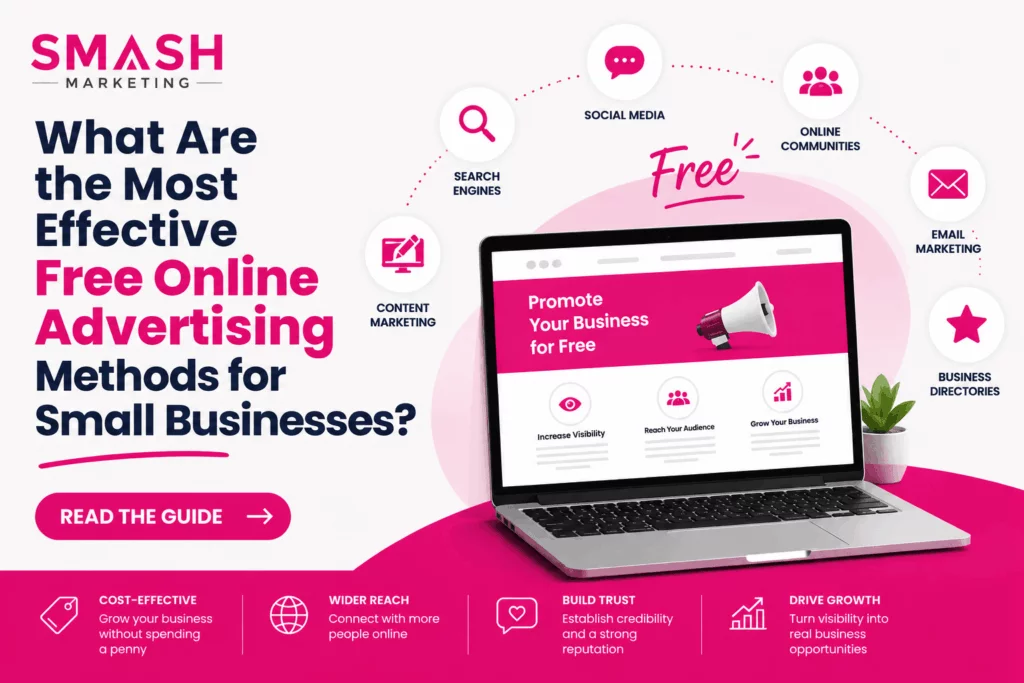
Image showing various advertising platform that are free to use for SMEs. 
Image Titled Free and effective online advertising methods for small businesses.

The good news is that "free" doesn't have to mean ineffective. Some of the highest-performing marketing channels require more time and expertise than financial investment, making them particularly valuable for growing businesses that wants sustainable results rather than short-term wins. 

The challenge is not about finding free online marketing ideas for  small businesses, as there are thousands online. The real challenge is identifying which activities will genuinely generate enquiries/ lead, support wider marketing strategy and continue to deliver value as the business grows. 

Whether you operate as an SME in manufacturing, professional services, construction, retail or e-commerce, the principles remain the same.  

Effective marketing is about reaching the right audience at the right moment with the right message.  

It is not simply appearing on every platform available. 

The most effective free online advertising methods for small businesses? 

The most effective free online advertising methods for small businesses are those that help potential customers discover your business when they're actively researching a product or service. Instead of interrupting people with advertising, these methods position your business where customers are already looking. 

For most SMEs, the strongest channels include: 

These channels perform different roles within your marketing strategy.  For example, SEO attracts new visitors, email marketing nurtures existing contacts, while reviews and referrals help build trust at the point of decision. 

Rather than treating them as separate activities, successful businesses combine them into a joined-up marketing strategy that supports long-term growth. 

Why is SEO still one of the best free advertising methods for small businesses? 

SEO remains one of the most valuable long-term marketing investments because it helps your business appear when prospects are actively searching for solutions. Unlike paid advertising, you are not paying for every website visitor. 

Businesses often search for small business free advertising ideas, expecting quick wins. While SEO requires patience, it continues working long after content has been published, making it one of the few genuinely sustainable marketing channels. 

For example, imagine a commercial accountant in Norfolk publishing detailed articles about capital allowances, tax planning and business growth. Those resources don't simply attract visitors, they answer questions that potential clients are already asking before they make contact. 

Good SEO in 2026 is no longer about repeating keywords throughout a page. Search engines increasingly reward businesses that demonstrate genuine expertise and create content that helps users make informed decisions. 

That means focusing on: 

One of the biggest mistakes SMEs make is treating SEO as a one-off project. In reality, SEO is an ongoing process of improving your website, expanding your content and refining pages based on customer behaviour. 

Businesses that consistently invest in SEO often find that their dependence on paid advertising gradually decreases over time. 

How can Google Business Profile support free local business advertising? 

If your business serves customers within a specific geographical area, your Google Business Profile is one of the most powerful forms of free local business advertising available. 

When someone searches for services "near me" or within your local area, Google frequently displays map listings before traditional website results. Appearing there can significantly increase website visits, phone calls and enquiries without spending anything on advertising. 

An effective profile should include: 

Many businesses create their profile once and rarely update it. That's a missed opportunity. 

Google increasingly favours businesses that maintain active profiles and regularly engage with customers. Simple actions such as uploading recent project photos or responding to reviews help demonstrate that your business is active, trustworthy and relevant. 

For SMEs competing within regional markets, this can often produce faster results than investing heavily in paid campaigns. 

Which small business advertising ideas deliver the best long-term value? 

The most effective small business advertising ideas aren't necessarily the newest or the most fashionable. They're the ones that continue generating enquiries long after the initial work has been completed. 

Content marketing is one of the best examples. 

Rather than producing sales-focused articles, successful businesses create genuinely helpful resources that answer the questions prospects ask before making a purchase. 

For example: 

This approach achieves several objectives simultaneously. 

It supports SEO by creating valuable content for search engines. 

It provides useful material to share on social media and in email campaigns. 

Most importantly, it positions your business as a knowledgeable, trustworthy supplier before a sales conversation even begins. 

One pattern we frequently see is businesses spending hours producing social media posts while neglecting the pages prospects actually read before making contact. 

In many cases, improving those pages produces significantly more enquiries than publishing another month's worth of social content. 

Is social media still worthwhile without paying for advertising? 

Yes. But its role has changed considerably. 

Organic social media is no longer the easiest way to reach completely new audiences. Instead, it is the most effective for reinforcing your expertise, maintaining visibility and building confidence among existing prospects. 

Rather than asking, "What should we post today?", ask, "What questions are our customers asking this week?" 

Content that performs consistently well includes: 

This type of content demonstrates credibility rather than simply filling a content calendar. 

For SMEs, that's often a far better use of time than chasing viral trends that generate plenty of engagement but very few commercial enquiries. 

Is Email Marketing One of the Effective and Free Online Advertising Methods for Small Businesses?

Yes, provided you're sending useful, relevant content rather than constant sales messages. 

Many SMEs overlook email marketing because it doesn't feel as exciting as social media or paid advertising. In reality, it's often one of the highest-performing marketing channels because you're communicating with people who have already shown an interest in your business. 

For growing businesses, email can support every stage of the customer journey. 

You might use it to: 

The businesses that see the strongest results don't email for the sake of it. They send content that helps customers solve problems, make decisions or stay informed. 

Email marketing also complements SEO and content marketing. Every time you publish a useful article or guide, you create another reason to reconnect with your audience and bring them back to your website. 

For SMEs with longer buying cycles, particularly in B2B sectors, that regular contact helps keep your business front of mind until prospects are ready to make a decision. 

Are customer reviews and referrals really a form of free advertising?

Absolutely. 

When prospective customers compare suppliers, they're often looking for reassurance rather than information. Reviews, testimonials and referrals provide that reassurance far more effectively than any sales message. 

Encouraging customers to leave reviews on Google and relevant industry platforms is one of the simplest forms of free local business advertising, particularly for businesses serving a defined geographical area. 

Reviews also support your wider SEO strategy by increasing trust and improving your visibility in local search results. 

Don't be afraid of the occasional negative review either. 

A thoughtful, professional response often creates a stronger impression than a page of perfect five-star ratings. 

Likewise, referrals remain one of the most valuable sources of new business for SMEs. 

Happy customers are usually willing to recommend you—they simply need to be asked at the right time. 

Should SMEs still use online business directories? 

Yes, but selectively. 

Not every directory offers genuine value, and adding your business to hundreds of low-quality websites won't improve your marketing. 

Instead, focus on trusted directories that your customers are genuinely likely to use. 

Examples include: 

Accurate business information across these websites also helps search engines verify your business details, supporting local SEO and improving consistency across the web. 

Combined with an optimised Google Business Profile, directories remain an effective part of a broader free online advertising methods for small businesses strategy. 

What mistakes can stop free online marketing from generating enquiries? 

One of the biggest misconceptions is that free online marketing produces free results. While these channels don't require large advertising budgets, they do require consistency, planning and ongoing improvement. 

Some of the most common mistakes include: 

Another common issue is treating each marketing activity in isolation. 

SEO, email marketing, social media and content marketing shouldn't compete for attention. They should support one another. 

For example, a single blog article can: 

That joined-up approach delivers significantly greater value than creating separate pieces of content for every channel. 

When does paid advertising become the best advertising for small business? 

When business owners ask about the best advertising for small business, they're often hoping for one perfect answer. 

The reality is more nuanced. 

Free online marketing channels build sustainable visibility over time, while paid advertising generates immediate exposure. For many SMEs, the strongest strategy combines both. 

For example, a manufacturer launching a new service could use Google Ads to generate enquiries straight away while simultaneously investing in SEO content that builds long-term rankings. 

Similarly, an ecommerce retailer might use paid social advertising to promote seasonal offers while email marketing encourages repeat purchases from existing customers. 

The goal isn't choosing between free and paid marketing. 

It's understanding when each channel contributes most effectively to your wider business objectives. 

Businesses that rely entirely on paid advertising often see enquiries disappear the moment campaigns stop. 

Businesses that invest only in organic marketing may struggle to generate short-term growth. 

A balanced strategy provides both immediate opportunities and long-term resilience. 

Should you manage your marketing internally or work with an agency? 

That depends on your internal resources, expertise and commercial priorities. 

Many SMEs have capable in-house marketing teams but limited capacity. Managing SEO, PPC, email marketing, social media, content creation and website optimisation simultaneously is a significant undertaking. 

An experienced agency should never begin by recommending every available service. 

Instead, it should start by understanding your commercial objectives before identifying the activities most likely to achieve them. 

That's often where businesses see the greatest value. 

Rather than delivering disconnected campaigns, an agency can ensure every marketing channel supports the same strategy, helping you generate better returns from the time and budget you're already investing. 

It's an approach that agencies such as Smash Marketing adopt, focusing on practical, measurable marketing rather than unnecessary complexity. 

Final thoughts 

The most effective free online advertising methods for small businesses aren't hidden shortcuts or the latest marketing trend. They're proven activities that consistently help customers find your business, build trust and encourage meaningful action. 

Whether you're researching small business advertising ideas, exploring small business free advertising ideas, looking for opportunities in free local business advertising, or deciding on the best advertising for small business, success comes from building a marketing strategy where every activity supports the next. 

When these channels work together, your marketing becomes far more effective than any individual campaign. 

If your current marketing feels reactive or disconnected, it may be time to step back and review how each activity contributes to your wider business goals. Whether that's something you manage internally or with the support of an experienced agency like Smash Marketing, a clear, integrated strategy is far more likely to deliver sustainable growth than chasing the latest trend or platform. 

Home » Archives for Anesa Bird

Frequently Asked Questions 

What are the most effective free online advertising methods for small businesses? 

The most effective methods include SEO, Google Business Profile, content marketing, email marketing, customer reviews, social media and referral marketing. Together, these channels help SMEs attract qualified traffic, build trust and generate enquiries without relying solely on paid advertising. 

What is the best advertising for small business? 

The best advertising for small business depends on your goals, audience and budget. Most SMEs benefit from combining long-term channels such as SEO and content marketing with targeted PPC campaigns when immediate results are required. 

What are some practical small business advertising ideas? 

Some of the most effective small business advertising ideas include publishing helpful content, improving your Google Business Profile, collecting customer reviews, sending valuable email newsletters and creating educational social media content that answers customer questions. 

Does free local business advertising still work? 

Yes. Free local business advertising remains highly effective, particularly when your Google Business Profile is fully optimised, your business information is consistent across trusted directories and you're actively collecting customer reviews. 

How long do free online advertising methods take to generate results? 

Some activities, such as improving your Google Business Profile or encouraging customer reviews, can generate enquiries relatively quickly. Others, including SEO and content marketing, often take several months to build momentum but usually provide stronger long-term returns.